

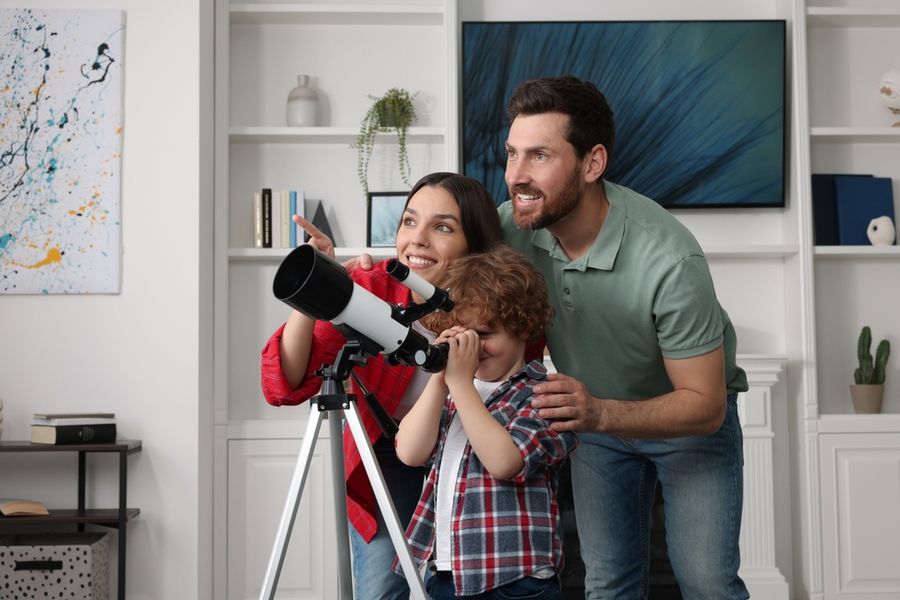
Suburban skies can still be great for stargazing, even with streetlights and porch lights nearby. The key is picking a telescope that is simple to set up, easy to point, and good at showing the Moon, planets, and a handful of bright deep-sky targets. Fortunately, many beginner-friendly models work well in typical U.S. suburbs. Understand a few practical tips to help you get clearer, brighter views on your first night out.
What Suburban Stargazing Does Best
In many suburbs, the Moon and planets are your best “wow” targets. They stay bright even when the sky background looks gray instead of black. Jupiter’s moons, Saturn’s rings, and the craters on the Moon can look sharp through a modest telescope.
Bright star clusters and a few galaxies can also be visible, but they may look faint and hazy compared to photos. A good first telescope should make the easy targets easy, while still giving you room to explore more later.
Easy Wins: Beginner-Friendly Refractors
Refractor telescopes use lenses, and they are often the simplest type for new users. They tend to hold alignment well, so you spend more time observing and less time adjusting. For suburban viewing, a small refractor can be a solid choice for the Moon, Venus, Jupiter, and Saturn.
Good options to look at include the Radian 75MM Petzval Refractor Telescope, or the Sky-Watcher EvoStar 80 ED APO Refractor Telescope. These kinds of telescopes are also nice if you want quick sessions on a weeknight. Keep expectations realistic for faint objects, but for bright targets, a refractor can be clean, crisp, and low-stress.
The Best All-Around Pick: Small Tabletop Dobsonians
If you want strong performance in a compact package, a tabletop Dobsonian is hard to beat. These are reflecting telescopes that sit on a sturdy base and move smoothly by hand. In suburbs, the extra light-gathering power helps star clusters look richer and makes it easier to spot brighter deep-sky objects.
You will need a stable surface, like a patio table or a solid crate, but once set up, they are quick to aim and very rewarding. They are also a great fit if you want to share views with family, since the eyepiece position is usually comfortable for kids and adults.
Quick and Guided Viewing: Smart-Assisted Telescopes
If you like the idea of help finding objects, a telescope with assisted pointing can be a game changer. This is especially helpful in suburbs, where fewer stars are visible to guide your aim. Assisted systems help you locate targets without needing to memorize the sky.
A strong option is the Celestron StarSense Explorer DX 130AZ. It pairs with a phone to guide you to planets, nebulae, and clusters. Another route is a GoTo telescope that finds objects for you after a short setup routine. The Celestron NexStar 4SE is a well-known example. These options can cost more than a basic manual scope, but they can reduce frustration and help you see more in a single session, which is often what beginners want.
What to Look For Before You Buy
Focus on ease and stability. A shaky mount can ruin the view, even with a good telescope. Look for a mount that feels solid and moves smoothly. Also, think about where you will store the telescope and how far you will carry it. The best telescope is the one you will actually use.
Pay attention to the included eyepieces. Many starter kits come with a couple that are usable, but you may want to add one higher-quality eyepiece later for sharper views. If you plan to observe planets often, a simple moon filter can also make the Moon more comfortable to look at. Finally, consider how you want to observe: manual “push-to” can be relaxing, while assisted or GoTo can help you see more targets fast.
Simple Tips That Make Suburban Views Better
Try to block direct light. Standing in the shadow of your house, setting up behind a fence, or using a simple dark hood can improve contrast. Give your eyes time to adjust, and dim your phone screen if you use one. When possible, observe later in the evening, after some neighborhood lights turn off.
Start with bright targets and build confidence. The Moon is perfect for learning focus and tracking. Then move to Jupiter and Saturn when they are up. After that, try bright star clusters like the Pleiades, or the Orion Nebula when it is in season. Keep a small notebook of what you saw and which eyepiece you used. That habit helps you learn faster than you might expect.
A Simple Setup Leads to More Nights Under the Stars
For casual suburban stargazing, you do not need a complicated telescope. A small refractor can be clean and easy, a tabletop Dobsonian can give a big jump in brightness, and smart-assisted models can make finding targets far less stressful.
Choose a telescope that fits your space, your patience level, and how you like to learn. Once you get a stable setup and a few favorite targets, stargazing becomes a relaxing habit you can return to all year.